 Feb 18, 2026–If I had to learn to read today, I would be illiterate.
Like most of you, I learned to read and write a lifetime ago. I’ve been a teacher, author, columnist, songwriter, and I even wrote letters in cursive when stamps only had presidents on them.
However…
If you held a leaky BIC pen to my white shirt, I could not tell you the difference between subjunctive and preterit tense, define a dangling participle or a prepositional phrase, or explain why it is wrong to split an infinitive or end a sentence with a preposition. Why do we keep trying to teach these obscure rules of grammar to our kids? Memorizing these at age 10 makes no one a better writer.
Of course, I do understand adjectives and adverbs, subject-verb agreement, and the Oxford comma. We all read Strunk & White. Many times. And, you know what? Those rules will always be there if you ever need to look them up. (Note: you never will.)
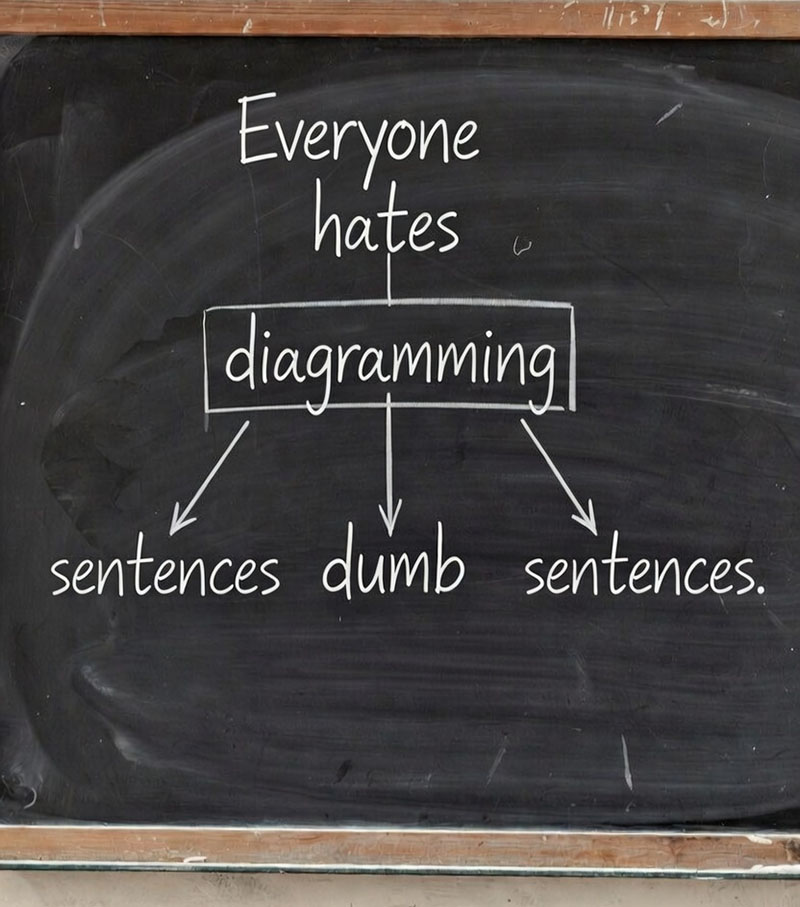
In eighth grade, our earnest Language Arts teacher took great pride in standing us at the blackboard to diagram sentences one would never hear or use in general speech. Those lines live in my memory as labyrinths to meaninglessness.
Yet today I can swear on a stack of Funk & Wagnalls that I have never… never ONCE… needed to diagram a sentence to enhance any kind of communication. The only role of the grammar purist is to correct someone’s typos online or become an 8th grade Language Arts teacher. Both make you unpopular.
Sorry, Euclid, I am convinced there IS a royal road to learning, and it really is just any worn path. If you want to learn how to do anything, just do it.
If you want to read, read.
If you want to paint, paint.
If you want to play guitar, play guitar.
If you want to be a cartoonist, draw cartoons.
After all, kids learn to talk in less than two years, without using an app. Babies don’t need a YouTube video to learn how to walk. You don’t need to be a chef to scramble eggs. I learned to sew by using a sewing machine.
The best way to kill interest in any subject is to hire a pedagogue to teach it to you. They are always more obsessed by rules than outcomes.
Personal Case Studies:
1) I wanted to learn music theory. So I joined a country band playing piano. Within a few months of playing Hank Williams and Patsy Cline songs without written scores, I knew music theory.
2) I hired a classical guitar player to teach me to play classical guitar. He spent the first lesson teaching me music theory. I already knew music theory (see #1). So I quit and bought a book on how to play banjo.
3) I wanted to study linguistics. I yearned to study the development of language. I was curious how it evolved from initial grunts by cavemen grilling an auroch over dinosaur dung, into the elegant prose of Shakespeare.
I was accepted into a degree program. My first courses? One year of statistics–computing probabilities, modeling, and curve equivalents (or as one cynical student referred to them–scurvy elephants).
A sample problem from the course syllabus: If the consonant cluster [st] is 110 milliseconds (ms) long, and the [s] is 100 ms longer than the [t], how long is the [t]?
This has nothing to do with how you pronounce “tea” in China.
So I quit and read a book by John McWhorter.
At this point, I don’t even remember the reason I started this column. Maybe I do need to learn more about language.