 April 1–I showed a young person my column last week, and when she got to the bottom of the page, she asked, “Where is the rest of it?”
I realized she didn’t understand how to read the “jump line” at the bottom of the column.
It’s easy to laugh. But then I realized there are now at least two generations that didn’t grow up reading newspapers.
Sobering, that.
Like most if not all of you, I was weaned on newsprint. My parents subscribed to weeklies from three neighboring towns along with the county seat daily. I read them all, from headlines to garden club news to obits.
When we moved to the city, my dream was to become a paperboy. You can imagine my excitement when the circulation department allowed me to become a neighborhood carrier even though I was a few months shy of the 12-year-old minimum age limit.
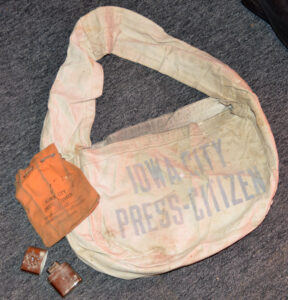
Every afternoon I raced home from school to pick up the bale of newspapers they dumped on our lawn. I remember the intoxicating smell of print and ink as I hauled them onto the porch, breaking the strap and counting them to make sure I had 54 copies for my customers. I transferred them to my canvas bag with Press-Citizen stenciled in blue, and marched off to spend two hours delivering the dailies to my customers in neighborhoods, apartments, and trailer parks. I walked past a cemetery at dark, and left copies at the local tavern.
I became a more avid reader. I followed our university sports teams, whose quarterback was on my route. I remember headlines that moved me deeply, from every new launch of an astronaut to the death of Pope John XXIII. It was visceral. One day I read about the murder of a wife in a house along my route. I already knew about it, I realized with horror, as I had smelled the decay of human death the day before the police found her stuffed in a closet.
Every Saturday I rode my Schwinn bike 23 blocks to the newspaper office, which took up a city block and looked like something out of Citizen Kane. I marched in and settled my bill, and usually walked out with $5 for my week of work, a vast fortune for a 12-year-old boy in the 1960s. I crossed the street and bought a Long John from Barbra’s Bakery, then rode across town to the Hobby Shop, where I usually spent the rest of my earnings on a slot car accessory. Newspapers were my ticket to the good life.
When we moved back to the small town, I gave up the route, but I achieved an unexpected upgrade. As reporter for my 4-H club, my reports actually appeared monthly in the local weekly. You can’t imagine the thrill of seeing your words printed in the newspaper everyone read, even if it was only describing someone presenting a program on “how to pack a suitcase.”
The love affair continues. I now have more than 20 years of weekly columns along with tons of articles that have appeared in all types of inked pages.
I know that time will render print media irrelevant, yellowing and disintegrating metaphorically the same way those clippings of 4-H reports have done in my scrapbook.
I recognize it, but I don’t have to accept it.
People don’t realize that the concept of a local newspaper–or local radio and TV–is not the medium it is printed or played on. The news is the people who do the work. The reporter who trudges to less-than-riveting meetings of city, county, and school boards, trying to make interest-and-sinking funds sound interesting. The DJs who discuss local events. The streamers who present local sports teams. Even the social media lurkers who breathlessly share how much rain they got.
But what the new media influencers take for granted is engagement. While dancing girls and public pranks draw eyeballs, they don’t change behavior. What they lack is what old-time advertisers learned at the advent of the radio and TV ages–stories must be sticky. They need to connect to the audience, in whatever format they appear.
That’s what we’re losing when the last edition is published.